Referring Domains vs Backlinks: What the Difference Is and Why It Matters for SEO
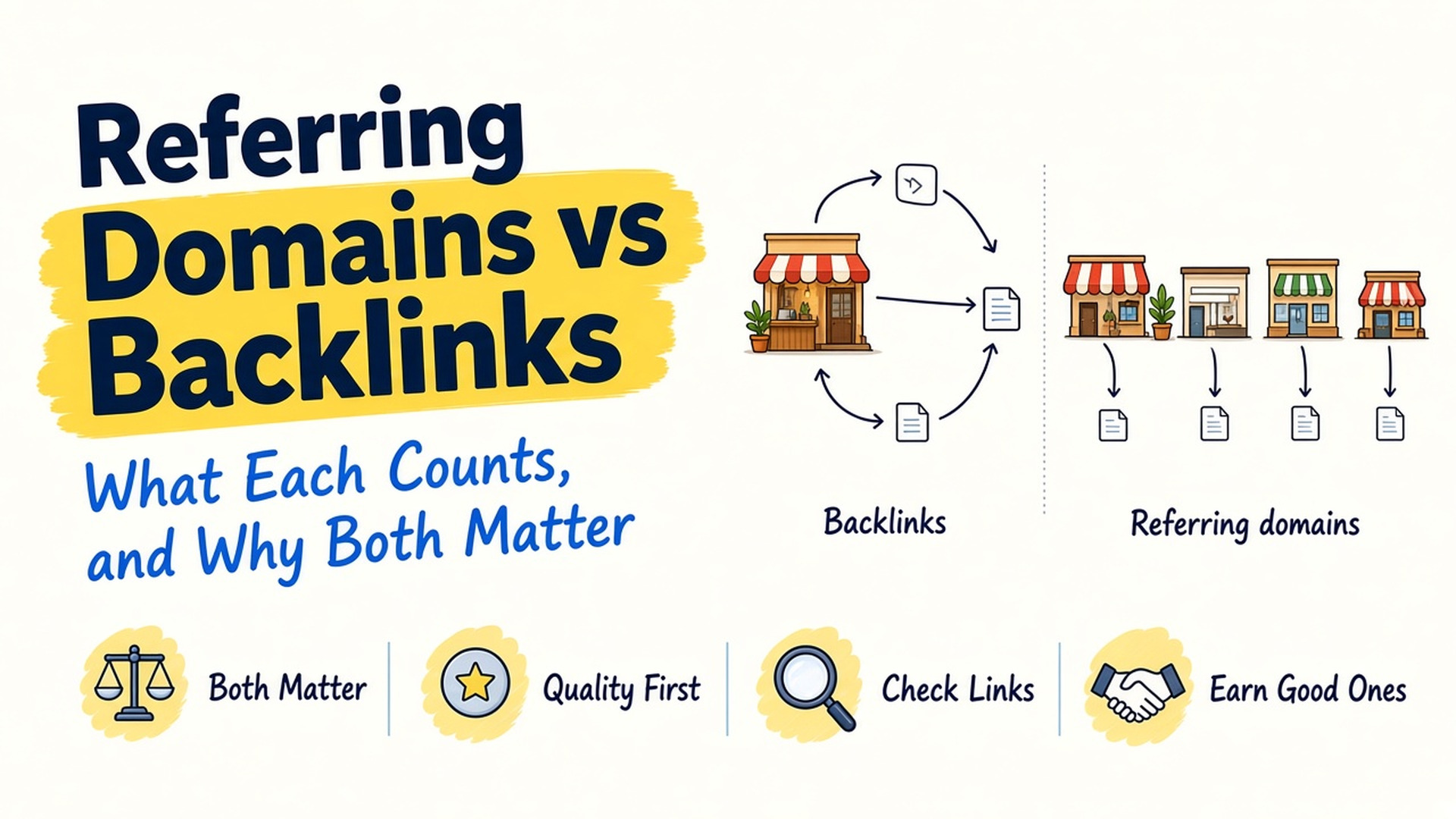
If you have ever looked at a link report, you have seen two numbers that sound almost the same: backlinks and referring domains. They are not the same, and mixing them up leads to the wrong conclusions about how well your SEO is doing.
This post explains the difference in plain words, why both matter, what to ignore, and how to earn links without risking a penalty. It is for business owners and marketers who read SEO reports and want to know what they are looking at.
What a backlink is
A backlink is a link from another website to a page on yours. Google treats links as one of the signals that other sites find your content worth pointing to, much like a recommendation. That is why backlinks matter for SEO, and why quality matters far more than quantity.
What a referring domain is
A referring domain is a website that links to you. If one site links to you ten times, that is ten backlinks but only one referring domain.
| What it counts | Example | |
|---|---|---|
| Backlinks | Every individual link pointing to your site | Ten links from one blog = 10 backlinks |
| Referring domains | The number of different websites linking to you | Those ten links from one blog = 1 referring domain |
Say a site has 200 backlinks that come from only five websites. It looks strong in one report and weak in another. The second number tells you far more about how widely you are trusted.
Why you should look at both
- Backlinks show how much link activity you have, including from a single generous source.
- Referring domains show how many separate sites vouch for you. A wide, varied set is a healthier sign than a lot of links from a few places.
If your backlinks are high and your referring domains are low, you may be depending on a few sources. That is fragile, and worth fixing.
Quality beats quantity
A link from a relevant, respected site in your field is worth far more than dozens from sites that have nothing to do with you. Ask of every link: would a real person find this useful, and does the site make sense for my business?
What about domain authority and similar scores?
Tools such as Ahrefs, Semrush and Moz give sites scores, often called Domain Authority or Domain Rating. They are useful for comparing sites, but they are the tool makers’ own measures. Google has said it does not use them in its rankings. Use them as a rough guide, not as a target.
How to check your own links
Google Search Console has a Links report that shows your total external links, the sites that link to you most and your most linked pages. It is free, and it is a good first look. Paid tools show more detail.
How to earn good links
- Create something worth linking to. Original research, a useful guide, a free tool or a clear explanation of something people struggle with.
- Build real relationships. Industry associations, partners, suppliers and local events often lead to genuine mentions.
- Contribute useful ideas. Guest posts can help when they are genuinely useful to that site’s readers. See our guest blog email templates and our guide to link building that Google counts.
- Get covered. Press, podcasts and industry features bring links as a by-product. Our post on PR versus backlinks covers how the two differ.
- Keep it varied. Links from many different relevant sites look natural and are healthier.
What to avoid
- Buying links or joining link schemes. Google’s spam policies treat these as link spam.
- Mass guest posting with keyword-rich anchor text.
- Irrelevant sites that exist only to sell links.
- Chasing the number. More links are not better if they are low quality.
Nofollow links, which tell Google not to pass credit, still bring visitors and can build your name, so they are not worthless. Google treats them as hints. Our post on link building patterns that backfire shows what to steer clear of.
A note on the disavow tool
Some guides tell you to disavow “toxic” links regularly. Google says its disavow tool is an advanced feature, to be used with caution, and most sites do not need it. See Google’s disavow help page. If you have a manual action or a clear case of spam links you cannot remove, it may apply. Otherwise, put your effort into earning good links.
A backlink is one link to your site. A referring domain is one website that links to you, however many times.
Look at both: backlinks show link volume and referring domains show how widely you are trusted.
Quality and relevance matter more than numbers, and tool scores like Domain Authority are not used by Google.
Earn links with useful content, real relationships and press. Avoid buying links and mass guest posting.
FAQs
What is the difference between backlinks and referring domains?
A backlink is a single link from another site to yours. A referring domain is a unique website that links to you. Ten links from one site count as ten backlinks and one referring domain.
How many referring domains do I need?
There is no fixed number. It depends on your market and competitors. Aim for steady growth in relevant sites that would genuinely send you visitors.
Does Google use Domain Authority or Domain Rating?
No. Those are measures made by SEO tool companies. Google says it does not use them in its rankings, so treat them as a rough guide.
Are nofollow links worth getting?
Yes, they can still send visitors and build your name. Google treats them as hints and does not pass the same ranking credit, so do not rely on them alone.
Want links you can be proud of?
Tell us about your business. We will tell you honestly where your links stand and which kind are worth earning first.
Prefer WhatsApp or a call? +91 99131 53530. The first conversation costs nothing.