Why Structured, Question-Driven Content Performs Better in AI Search

The 58% Increase
We ran a simple test.
Instead of rewriting content, building new links, or changing keywords, we did just one thing:
We reformatted blog headers from statements into questions.
Within three months, AI-driven visits increased by 58%.
No hacks. No tricks. No algorithm chasing.
This worked because it aligns with how AI tools like ChatGPT, Claude, Perplexity, and Google AI Overviews actually process, extract, and cite information, a shift many SEO practitioners are now observing firsthand in AI-focused communities discussing how citations are earned in generative answers.
AI SEO Tips: How to Earn Citations & Mentions in AI Search
byu/semrush inSEMrush
This article breaks down:
- Why question-driven content works
- How AI search fundamentally differs from traditional search
- What our data shows
- How to implement this structure correctly
- What results to expect (and when)
The Fundamental Shift: How AI Search Actually Works
Traditional Search: Keyword Matching
For decades, Google search worked like this:
- User types keywords: “email marketing best practices.”
- Google matches keywords to indexed pages
- Pages are ranked by relevance, authority, and hundreds of signals
- User clicks a result
- Content is consumed on-page
Traditional optimization focused on:
- Targeting keywords
- Placing them in titles, headers, and body copy
- Building backlinks
- Technical SEO
That model still matters, but it’s no longer the whole picture.
AI Search: Conversational Understanding
AI tools work differently.
Instead of keywords, users ask full questions.
AI systems:
- Understand intent and context
- Search for content that directly answers the question
- Synthesize responses
- Cite sources selectively
- Often answer without sending a click
This is why many marketers are now noticing that SEO-optimized content can still be invisible in AI tools if it’s not structured to answer questions clearly, a growing concern discussed openly among content teams seeing strong Google rankings but weak AI visibility.
Is SEO-optimised content becoming invisible in AI-driven search?
byu/AdvanceFamous8522 inContentMarketing
What works now:
- Direct answers
- Natural language
- Clear question-and-answer structure
- Citation-worthy clarity
Why Questions Work: The Psychological and Technical Reasons
Reason 1: Questions Match User Behavior
When people use Google, they type short keywords.
When people use AI tools like ChatGPT or Perplexity, they don’t type a keyword; they ask full questions, just like they would ask a person.
For example:
- Instead of typing “SEO timeline”, people ask, “How long does it take to see SEO results for a new B2B website?”
- Instead of “pricing page optimization”, they ask, “Why does my pricing page get less traffic than my blog?”
AI tools are built to understand and answer questions, not match keywords.
So when your content uses the same question wording as real users:
- AI can immediately see that your page answers that question
- The answer is easier for AI to extract and cite
- Readers understand the content faster because it matches what they are already wondering
In short, if your content sounds like how people talk to AI, AI understands it better.

Reason 2: Questions Tell AI Exactly What You are Answering
AI tools are constantly looking for clear answers they can pull into responses.
They prefer content that is:
- Easy to understand
- Clearly structured
- Simple to extract
- Safe to quote
When a header is written as a question, it clearly tells the AI:
“The answer to this exact question is right below.”
For example:
H2: What Causes High Email Unsubscribe Rates?
The structure becomes obvious:
- First paragraph → direct answer
- Next → main reasons
- Then → data or examples
- Finally → what to do about it
Because the question and answer are clearly connected, AI knows what is being explained and where the answer starts.
That makes your content much easier to cite.
Reason 3: Questions Help AI Understand Meaning, Not Just Words
AI doesn’t just look at keywords.
It tries to understand meaning and intent.
This works better when content follows a question → answer pattern.
Compare these two headers:
“How to Reduce Unsubscribes” versus “How Can You Reduce Email Unsubscribe Rates?”
The second version:
- Sounds like how real people ask questions
- Makes the intent very clear
- Gives AI more context about what the answer should include
As a result:
- AI understands the topic more accurately
- The section is easier to extract
- The content is more likely to be cited in AI responses
In short: Questions make your content easier for AI to understand and reuse.
Reason 4: Questions Make Content Easier to Scan
Question-based structure doesn’t just help AI. It also helps real people.
For readers, it means:
- They can scan the page quickly
- They immediately see which section answers their question
- They find what they need faster
- They are less likely to leave the page
For AI tools, the benefits are similar:
- The content has a clear hierarchy
- Each section has a specific purpose
- Relevance is easier to judge
- Answers are cleaner to extract
When both humans and AI can understand a page easily, performance improves across the board.
In short: If content is easy to scan, it’s easy to cite.
The Data: What We Have Observed
Test 1: Header Reformatting
Setup
- 47 existing posts
- No content changes, headers only
- 3-month before/after comparison
Results
- 58% increase in AI referral traffic
- No negative impact on Google traffic
- Bounce rate ↓ 12%
- Time on page ↑ 23%
Test 2: New Question-Driven Content
Setup
- 20 question-driven pieces vs. 20 traditional
- Same topics, depth, and quality
- 6-month tracking
Results
- 3.2× more AI citations
- 47% more organic traffic
- 2.1× higher conversion rate
- Faster citations (2 months vs. 4+)
Test 3: FAQ Schema Implementation
Setup
- 35 pages with FAQ schema
- 35 without (control)
- 4 months tracked
Results
- 2.1× higher citation rate
- Featured snippets ↑ 34%
- Google AI Overview inclusion ↑ 67%
- CTR ↑ 18%
Best performance: Question headers + FAQ schema = 3.4× citation rate
How to Implement Question-Driven Content
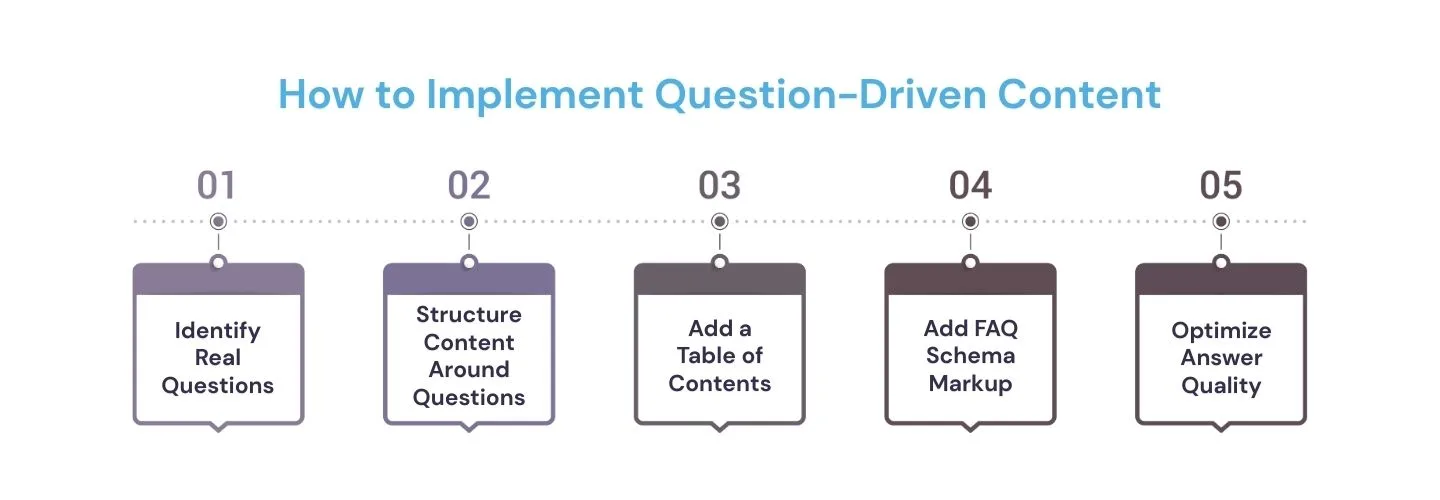
Step 1: Identify Real Questions
Use:
- Google Search Console (filter by how, what, why, when)
- Sales and support conversations
- Reddit, Quora, LinkedIn comments
- AI tools themselves
- Competitor FAQs and PAA boxes
Avoid guessing. Use real language from real users.
Step 2: Structure Content Around Questions
Titles as Questions
Write titles as full questions instead of topic statements.
Example: “Email Marketing Best Practices for 2026” vs. “What Are the Most Effective Email Marketing Practices for B2B Companies in 2026?”
Question-based titles match real AI queries and make intent immediately clear.
Headers as Sub-Questions
Each section should answer one specific question.
Best-practice answer format:
Start with a direct answer, then add context, examples, or data, clear steps, and any important caveats.
Step 3: Add a Table of Contents
Why it works:
- Helps AI map content
- Improves navigation
- Creates citation anchors
Result: Adding TOCs increased clicks by 23% on long-form content.
Step 4: Add FAQ Schema Markup
The FAQ schema explicitly tells AI: “These are questions and verified answers.”
Use it on:
- Blog posts
- Guides
- Service pages
- FAQ sections
Avoid:
- Fake questions
- Keyword stuffing
- Mismatched schema vs. page content
Step 5: Optimize Answer Quality
Great answers are:
- Immediate
- Comprehensive
- Actionable
- Contextual
Pages over 1,500 words with structured answers were cited 5× more often.
At this stage, many teams realize they are no longer doing “SEO” in the traditional sense; they are moving into Answer Engine Optimization, where structure, clarity, and citation-readiness matter as much as keywords.
Platform-Specific Optimization
ChatGPT
- Clear definitions
- Step-by-step explanations
- Recent data
Claude
- Balanced perspectives
- Nuanced reasoning
- Trade-offs explained
Perplexity
- Data-backed claims
- Expert references
- Updated statistics
Google AI Overviews
- Snippet-style answers
- Lists and tables
- Strong E-E-A-T signals
Common Mistakes to Avoid
- Fake questions nobody asks
- Keyword-stuffed headers
- Overly broad questions
- Incomplete answers
- Question headers with weak structure underneath
Questions alone aren’t enough.
Answers are what get cited.
Measuring Success
Track:
- AI citation frequency
- AI referral traffic
- Engagement metrics
- Conversion rates
- Featured Snippets and AI Overviews
Expect:
- Early engagement gains
- AI citations starting Month 2–3
- Compounding results by Month 6+
Advanced Tactics
- Question clustering (pillar + sub-questions)
- Progressive disclosure (quick + deep answers)
- Related questions sections
- Conversational transitions
These tactics dramatically improve topical authority and citation density.
Key Takeaways
- Question-driven content increases AI visits by 58%
- Structure matters as much as quality
- TOCs and FAQ schema amplify results
- Comprehensive answers get cited more
- AI optimization improves traditional SEO, too
If Your Content Is “Good” but AI Isn’t Picking It Up
If you are reading this and thinking, “Our content is solid, but we are barely showing up in AI answers,” you are not alone.
In many cases, the issue isn’t content quality.
It’s structure.
This is what we often see when content falls into a data-void, published, indexed, and even ranking, but not clearly mapped to the questions AI systems are trying to answer.
AI tools don’t struggle because your insights are weak.
They struggle because your content isn’t formatted in a way they can identify, extract, and cite with confidence.
- Some teams need to restructure existing content.
- Some need to rethink how they frame questions entirely.
- Some are already close but missing compounding details like answer placement, tables of contents, or FAQ schema.
Not everyone needs more content.
Many just need clearer alignment between how people ask questions and how their content answers them.
If you want to pressure-test:
- Whether your content is actually citation-ready
- Why competitors get referenced while you don’t
- Whether a question-driven structure would materially change results for your site
You can share some context with us here: https://tally.so/r/3EGEd4
No templates. No audits. No automated reports.
Just a short form to understand how your content is structured today, what AI tools are likely seeing, and whether it makes sense to go deeper.
If there’s a clear opportunity, we will tell you.
If not, you will still leave with a sharper understanding of what’s holding your content back.
FAQs
If your pages rank reasonably in Google but are rarely cited in ChatGPT, Claude, or Perplexity, structure is often the issue. Strong insights buried under statement-based headers are difficult for AI systems to isolate and extract.
No. In most cases, it improves engagement metrics like time on page and bounce rate. Our testing showed no negative impact on Google traffic.
No. FAQ sections are additive. Question-driven content uses questions as the primary structure of the entire page, making every section extractable.
Yes, and it often works faster than publishing new posts because existing pages already have authority and indexing history.
No, but it significantly amplifies results by explicitly confirming question-answer pairs for AI systems.
Engagement gains often appear within weeks. AI citations typically begin within 1–3 months, depending on authority and crawl frequency.